
Daily Pay and Earned Wage Access for Gig Workers in Singapore: A Practical Perspective
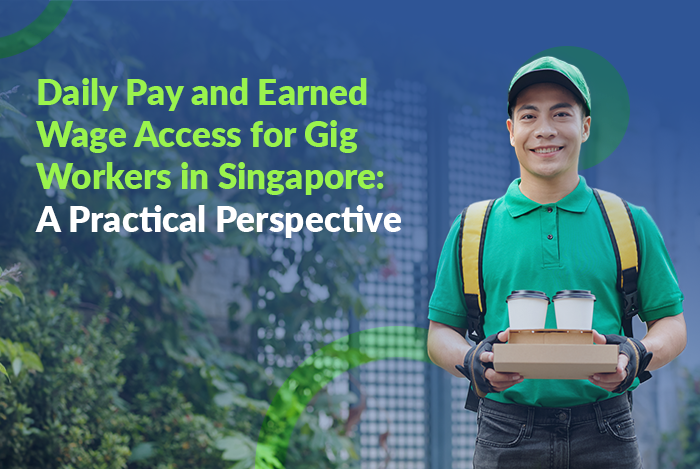
Singapore’s workforce has evolved substantially over recent years. Alongside traditional full-time employment, part-time, freelance, and platform-based roles have grown as workers seek flexibility and businesses adapt to changing labour needs. This trend is especially visible in sectors such as healthcare, hospitality, logistics, and retail, where flexible engagement models are increasingly common.
While these roles offer flexibility for workers and operational agility for businesses, they also expose a structural mismatch between how work is performed and how wages are typically paid. The long-standing monthly pay cycle was designed for stable, salaried employment. For workers paid by the hour, shift, or task, this model often does not reflect the day-to-day reality of managing expenses such as transport, food, utilities, and family obligations. In a high-cost city like Singapore, the timing of pay can matter almost as much as the amount.
As Singapore’s workforce continues to diversify, businesses across labour-intensive sectors are reassessing whether traditional monthly payroll systems still align with modern work patterns. This article takes a closer look at where Earned Wage Access (EWA) is most relevant in Singapore, and why certain industries and workforce models stand to benefit more than others as pay expectations evolve.
Labour Market Dynamics and The Gig Economy’s Presence in Singapore
Singapore’s overall labour market has remained resilient, with employment levels continuing to grow and unemployment rates staying low. According to the Ministry of Manpower’s Labour Market Report for 3Q 2025, total employment expanded by over 25,000 in the third quarter of the year, and overall unemployment remained around 2.0 per cent.
At the same time, low unemployment does not necessarily imply uniform employment experiences. As businesses respond to operational pressures and workers seek greater flexibility, non-traditional work arrangements have become more visible across multiple sectors.
This includes part-time, contract, and platform-mediated roles that operate outside conventional nine-to-five employment models and, in many cases, outside traditional monthly payroll expectations. Based on Ministry of Manpower (MOM) data, there were about 70,500 platform workers in Singapore in 2023, making up about 3 per cent of the workforce. Of these, 22,200 were cabbies, 33,600 were private-hire drivers and 14,700 were delivery workers.
Where the Traditional Pay Cycle Falls Short in Singapore
For many Singaporean gig and shift workers (or platform workers), income is earned daily but accessed weeks later. This gap can create cash flow pressure, especially when working hours fluctuate or unexpected expenses arise. While not all workers face financial stress, employers in high-turnover industries frequently observe patterns such as:
Employees requesting pay advances or informal loans
Increased absenteeism around pay dates
Higher churn among hourly and contract workers
From a business perspective, these issues translate into higher recruitment and training costs, lower engagement, and operational disruption. In sectors such as retail, F&B, and logistics, where margins are tight and continuity matters, even small improvements in workforce stability can have a meaningful impact.
Why Pay Flexibility Is Becoming a Workforce Expectation
Younger workers in Singapore entering the labour force tend to prioritise flexibility, transparency, and control, not only in working hours but also in how and when they are paid. Digital banking, real-time payments, and app-based services have reshaped expectations across many aspects of daily life, including personal finance.
For shift-based and gig workers, earlier access to earned income can help smooth short-term cash flow without relying on credit cards, payday loans, or informal borrowing. For employers, offering pay flexibility is increasingly seen as part of a broader employee value proposition, alongside scheduling flexibility and benefits.
Importantly, pay flexibility does not replace fair wages or stable hours. Instead, it addresses timing, giving workers access to money they have already earned.
Earned Wage Access Explained and Sectors Where EWA Is Most Relevant in Singapore
Earned Wage Access (EWA) allows employees to withdraw a portion of their accrued wages before the end of the pay cycle. These withdrawals are typically deducted from the employee’s salary on the regular payday. Properly structured EWA solutions are not loans and do not involve interest.
In practice, EWA can be used for everyday needs, such as commuting costs, groceries, or childcare, particularly for workers with variable schedules. From an employer standpoint, EWA can be positioned as a financial wellness feature rather than a compensation change. With FRIYAY’s EWA solution, workers can access earned paydays anytime, right on their mobile device.
While EWA is not necessary for every workforce, it tends to be most relevant in Singapore’s industries with hourly pay, variable shifts, or freelance arrangements:
Retail and Consumer Services
Peak periods, temporary staffing, and irregular shifts are common. Earlier access to wages can improve reliability and morale during busy trading cycles.
Food and Beverage
Income volatility due to shift changes or part-time work is common. EWA can help staff manage day-to-day expenses without financial strain.
Logistics and Delivery
Drivers and riders often incur upfront costs such as fuel and transport. Timely access to earnings can reduce financial friction and improve focus on service quality.
Healthcare and Elder Care
Shift work is the norm, and employees often balance work with caregiving responsibilities. Pay flexibility can support workforce sustainability in a sector facing long-term labour pressure.
Implementing FRIYAY’s EWA Without Operational Disruption
For employers, the viability of EWA depends on simplicity, compliance, and cost control. Modern EWA platforms (like FRIYAY’s EWA solution) are designed to integrate with existing payroll systems, automate reconciliation, and provide visibility over withdrawals. When implemented correctly:
Employers do not need to change pay structures or payroll schedules
Wage advances are limited to earned amounts
Administrative overhead remains minimal
Data protection and regulatory compliance are particularly important in Singapore. Any EWA solution must align with the Personal Data Protection Act (PDPA) and established payroll practices to ensure employee trust and business accountability.
Looking Ahead: Pay as Part of Workforce Strategy
As work patterns continue to diversify, employers will need to rethink how traditional systems support modern labour models in Singapore. Pay flexibility, including Earned Wage Access, is one tool among many to improve workforce resilience, engagement, and retention.
For businesses operating in labour-intensive sectors, the question is no longer whether workforce expectations are changing, but how quickly internal systems can adapt. Offering controlled, compliant access to earned wages can help bridge the gap between how people work today and how payroll has historically been designed.
A Practical Step Forward
For organisations exploring ways to strengthen employee engagement without increasing fixed costs, EWA is worth evaluating as part of a broader financial wellness and workforce strategy. The goal is not to replace monthly pay, but to complement it with flexibility that reflects the realities of modern work in Singapore.
Ready to Transform Your Payroll System?
If you want to provide your workers with the financial flexibility they need, FRIYAY can help. Visit friyay.asia to learn more about how our Earned Wage Access platform can improve employee retention, productivity, and engagement. Request a demo today and experience the impact for yourself.